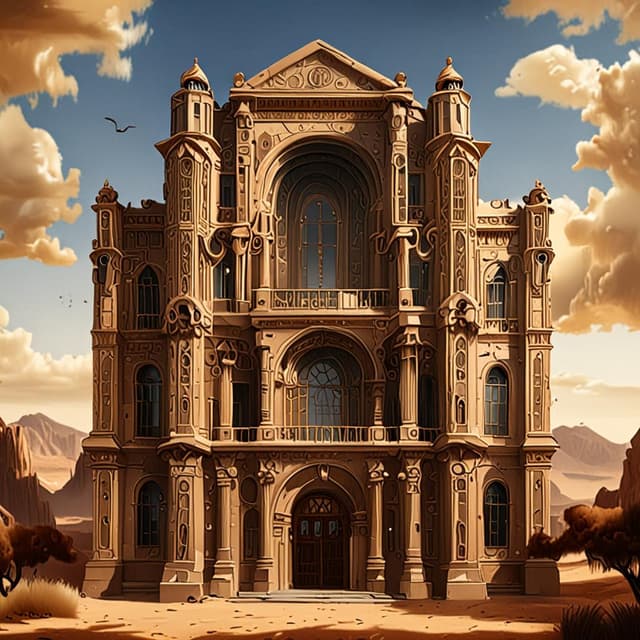
| Name | Library of Babel |
| Location | |
| Description | A vast repository containing every possible combination of characters, forming a collection of volumes that encompasses the entirety of recorded knowledge and all imaginable texts. |
| Construction | 17th century |
| Significance | An invaluable resource for scholars, linguists, and philosophers seeking to explore the limits of information and human understanding |
| Maintained by | A dedicated team of librarians |
| Exploration status | The full contents of the Library remain largely unexplored, but it continues to fascinate and perplex all those who encounter its seemingly infinite shelves. |
The Library of Babel is a monumental repository of books located in the remote desert region of New Castile, in the Kingdom of Spain. First constructed in the early 17th century, the Library contains every possible combination of characters that can be arranged into books, encompassing the entirety of recorded knowledge as well as all imaginable texts, both meaningful and nonsensical.
The origins of the Library of Babel can be traced to the visionary librarian and polymath Jorge Luis Borges, who first conceived of the idea in the 1630s. Inspired by emerging theories in mathematics and information theory, Borges envisioned a library that could contain the sum of all possible information and knowledge. He began lobbying the Spanish government to fund the construction of such a facility, arguing that it would serve as an invaluable resource for scholars and scientists.
After years of negotiation, the Library project was greenlit in 1655 under the patronage of King Philip IV. Construction commenced shortly thereafter in the vast, arid expanse of New Castile, chosen for its isolation and defensive seclusion. Borges oversaw the design and implementation, drawing upon the architectural innovations of the era to create the now-iconic hexagonal structure that houses the Library's shelves.
The full construction process took over 20 years and employed thousands of stonemasons, carpenters, and other laborers. Finally completed in 1676, the Library of Babel stood as an engineering marvel - a sprawling, multi-level complex of interconnected hexagonal chambers stretching as far as the eye could see across the desert landscape.
At its core, the Library contains every possible permutation of characters that can be arranged into volumes of approximately 410 pages. This includes not just meaningful books in known languages, but also volumes containing only gibberish, as well as texts in imaginary or undiscovered tongues. Estimates suggest the Library contains over 104,677,720,000,000 books - a number so vast as to be nearly incomprehensible.
The Library's vast collection is organized across a grid of interconnected hexagonal chambers, each containing shelves of leather-bound volumes. The exact nature of this organizational system remains a closely guarded secret known only to the Library's elite corps of trained librarians. What is clear is that the volumes are not arranged alphabetically, chronologically or by subject - their placement seems to follow an intricate, esoteric logic.
Throughout its history, the Library of Babel has served as an unparalleled resource for scholars, linguists, philosophers and others seeking to push the boundaries of knowledge and understanding. Researchers travel from across the world to delve into the Library's shelves, where they may stumble upon lost works of literature, decode long-forgotten languages, or discover entirely new branches of mathematics and science.
The very existence of the Library has also spawned profound questions about the nature of information, knowledge, and the human mind. If the Library truly contains every possible book, does that mean all knowledge already exists, waiting to be discovered? Or are there realms of meaning and understanding that lie forever outside the constraints of written language? These are the types of metaphysical quandaries that have vexed thinkers who have encountered the Library over the centuries.
Despite its irrefutable scholarly value, the Library remains a source of both reverence and trepidation. Its sheer scope and the unsettling prospect of containing all potential knowledge - both brilliant and nonsensical - have led some to view it as an object of horror and madness. Legends abound of librarians who have lost their sanity combing the infinite stacks, or of books that drive readers to despair with their disturbing revelations.
In the modern era, as the boundaries of human knowledge and technology continue to expand, the significance of the Library of Babel has only grown. It stands as a testament to our species' relentless drive to catalog, decipher and comprehend the limits of our world and our understanding. And it remains an enduring enigma, a mirror reflecting the vastness and complexity of the information that shapes our reality.
